主题演讲提案
2026 年 9 月 15 日(周二)
提交主题演讲提案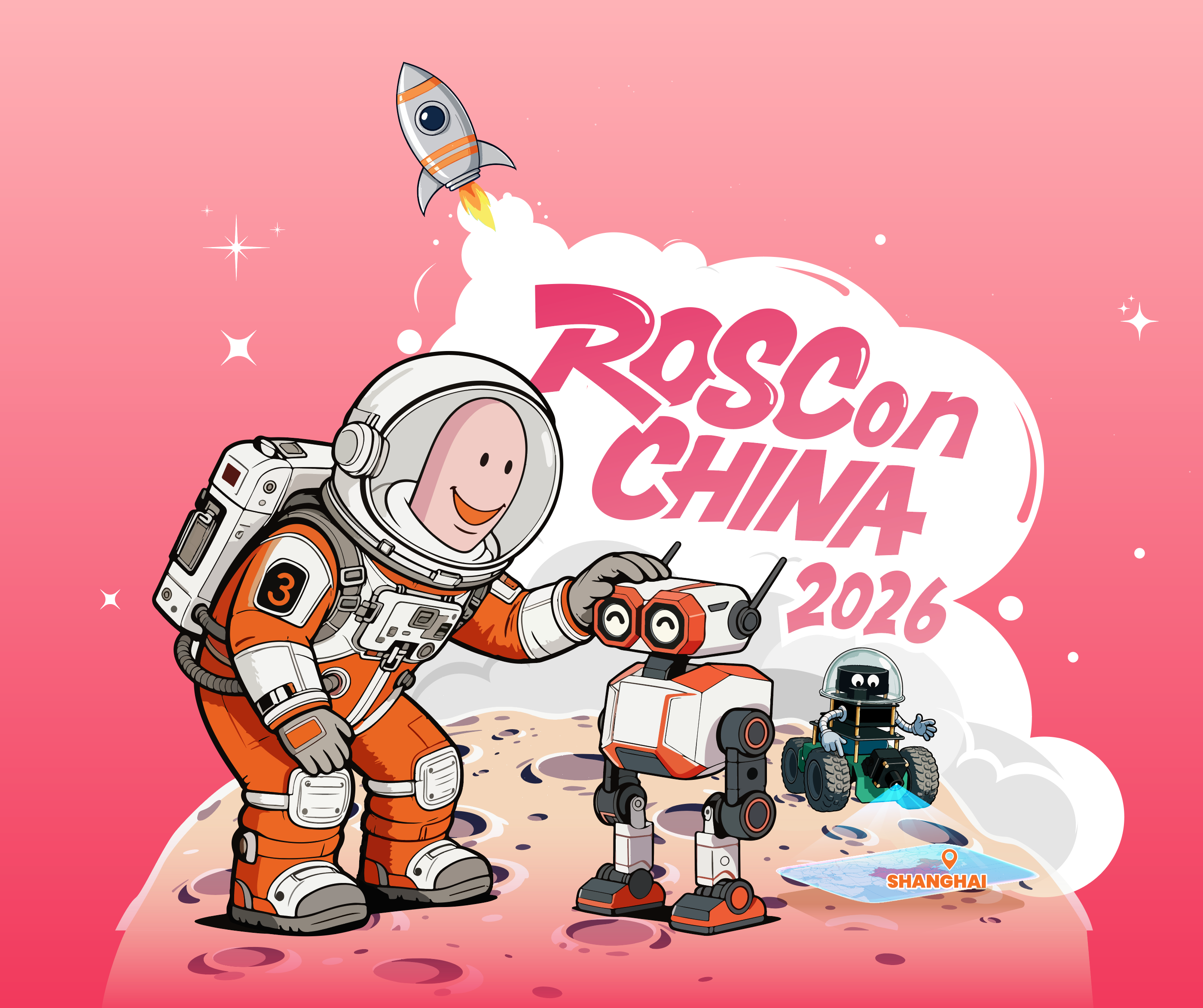
门票购买Tickets
微信小程序购票通道现已开放Ticket sales are now open via WeChat Mini Program
ROSCon China 2026
ROSCon China 2026 将于 10 月 16 日至 18 日在上海·美的全球创新园区举办。作为中国 ROS 社区的年度盛会,ROSCon China 致力于为各个水平的开发者——从初学者到资深工程师——搭建一个学习、交流与协作的专业平台。
本届 ROSCon China 延续开发者大会的定位,为期三天的议程涵盖技术报告、工作坊、专题讨论、闪电演讲与现场演示,聚焦新工具与新库的引入,以及现有技术的深入实践。来自 ROS 全球生态与中国机器人产业的一线贡献者将登台分享,带来这一年来真正落地、真正解决问题的经验与思考。
ROSCon China 始终以代表整个 ROS 社区为目标。我们欢迎每一位对机器人技术抱有热情的开发者参与,无论背景与经验。大会倡导开放、包容、尊重的交流氛围,所有参会者需遵守行为准则,共同维护良好的社区环境。
如果您对 ROSCon China 2026 有任何疑问、意见或想法,请联系组委会。ROSCon China 的成长,离不开社区每一位成员的参与。
ROSCon China 2026
ROSCon China 2026 will take place from October 16 to 18 at Midea Global Innovation Park in Shanghai. As the annual gathering of the ROS community in China, the conference provides a professional platform for developers at every level—from beginners to experienced engineers—to learn, exchange ideas and collaborate.
Continuing its focus as a developer conference, the three-day program includes technical talks, workshops, panel discussions, lightning talks and live demonstrations. Sessions will introduce new tools and libraries while exploring established technologies in depth. Contributors from the global ROS ecosystem and China’s robotics industry will share practical experience and lessons from solving real problems over the past year.
ROSCon China aims to represent the entire ROS community. We welcome everyone who is passionate about robotics, regardless of background or experience. The conference promotes open, inclusive and respectful exchange, and all attendees are expected to follow the code of conduct and help maintain a positive community environment.
For questions, comments or ideas about ROSCon China 2026, please contact the organizing committee. ROSCon China grows through the participation of every member of the community.
提案征集时间线
Call for proposals timeline
Tuesday, September 15, 2026
Submit a talk proposalTuesday, September 15, 2026
Submit a workshop proposalSunday, September 20, 2026
Submit a Lightning Talk感谢支持 ROSCon China 2026
感谢以下企业与社区伙伴对大会的支持。点击 Logo 可访问赞助商官网。
Thank you for supporting ROSCon China 2026
We thank the following companies and community partners for supporting the conference. Select a logo to visit the sponsor's website.

















共同建设 ROS 生态
我们现在正在接受 ROSCon China 2026 的赞助!ROSCon China 2026 依据国际 ROSCon 惯例,将设立钻石、铂金、金牌、银牌等多个赞助级别。为了办好 ROSCon China 2026 盛会,主办方与组委会诚挚邀请相关单位踊跃参与赞助,携手共同促进机器人操作系统(ROS)、智能机器人技术研究与产业发展。
联系我们有关 2026 年赞助福利的完整信息,请联系邮箱 roscon@guyuehome.com 获取。我们建议您尽快申请席位,ROSCon China 2026 的展位空间和赞助附加组件有限;如有任何问题或疑虑,请通过上述邮箱联系我们。
Building the ROS ecosystem together
ROSCon China 2026 is now accepting sponsors. In keeping with international ROSCon practice, sponsorship opportunities will include Diamond, Platinum, Gold and Silver levels. The organizers warmly invite organizations to support the conference and help advance ROS, intelligent robotics research and industry development.
Contact UsFor full details of the 2026 sponsorship benefits, please contact roscon@guyuehome.com. Exhibition space and sponsorship add-ons are limited, so we recommend reserving your place early. Please use the email address above for any questions.
会场信息与交通出行
上海市青浦区徐民东路 777 号。园区总建筑面积约 40 万平方米,紧邻国家会展中心,距离虹桥枢纽约 3 公里。
约 3 公里。乘地铁 2 号线至徐泾东站,4 号口出站后步行约 15 分钟;打车约 8-12 分钟。
可乘机场联络线至虹桥 2 号航站楼,再换乘地铁 2 号线;也可直接乘 2 号线至徐泾东站。
乘地铁 2 号线至徐泾东站 4 号口;虹桥商务区 2 路、徐泾 4 路可到园区正门。
导航“上海美的全球创新园区”。北门靠近地铁,南门连接地下停车场,西门适合自驾驶入。
Venue and travel guide
777 Xumindong Road, Qingpu District, Shanghai. The 400,000-square-metre innovation campus sits beside the National Exhibition and Convention Center, around 3 km from the Hongqiao transport hub.
About 3 km away. Take Metro Line 2 to East Xujing Station, Exit 4, then walk for about 15 minutes. A taxi takes about 8-12 minutes.
Take the Airport Link Line to Hongqiao Terminal 2 and transfer to Metro Line 2, or ride Line 2 directly to East Xujing Station.
Take Metro Line 2 to East Xujing Station, Exit 4. Hongqiao Business District Bus 2 and Xujing Bus 4 stop at the park entrance.
Search for “Midea Global Innovation Park, Shanghai”. The north gate is closest to the metro; the south and west gates are convenient for drivers.
面向 2026 的技术议题
20 个议题分为五条主线,覆盖从 ROS 2 通信架构到具身智能安全治理的完整工程链路。
ROS 2 Lyrical Luth 版本首次以 Zenoh 替代 DDS 作为默认中间件,本地延迟降至 20-50μm,跨网延迟降至 0.5-2ms,吐量提升 50%,开启从云端到微控制器的统一通信时代。
节点直接与 GPU/NPU 交互,消除冗余内存拷贝,为深度学习推理与点云处理提供数量级性能提升,rosidl::Buffer 加速器接口成为新标准。
从“导航→识别→抓取→放置”到多机协同任务编排,行为树正取代传统状态机成为复杂具身任务的标准范式,与 ROS 2 的集成更加紧密。
Rust 客户端库 rclrs 已达功能完整,内存安全与零开销抽象为安全关键场景提供新选择,ROS 2 多语言生态迈入新阶段。
自然语言指令经 LLM 拆解为 ROS 2 Action 序列,让机器人听懂“把红色零件放到 B 区”,从机械执行跃迁至自主决策。
TensorRT 量化、显存零拷贝、功耗动态平衡,大模型上机器人的实时推理工程实践,端侧 <200ms 推理延迟成为标配。
从传感器采集到训练数据集的标准化管线,解决数据准备占项目成本 60-80% 的痛点,多机器人数据集走向公共化。
Isaac Sim → Lab → ROS → Jetson,构建 NVIDIA 物理 AI 工具链的端到端工程实践,推动主流工业机器人平台全面接入。
图形化编程与 AI 辅助代码生成结合,标准化场景开发周期从数月缩短至 72 小时,新开发者培训时间减少 85%。
以 π0、GR00T N1、OpenVLA 为代表,探索视觉-语言-动作一体化范式如何从实验室走向产线,以及模型蒸馏带来的端侧部署机会。
慢系统以 2-5Hz 做规划,快系统以 200Hz+ 做控制,类脑双系统架构推动模型集成策略从单一通用模型走向专家模型联邦。
市场关注点从“能否工作”转向“是否划算”,“危险场景替代”与“情感陪伴”成为两条主要商业化路径。
零真实数据训练与高成功率迁移推动仿真到现实从“碰运气”走向“带着物理认知进入真实世界”,接触动力学与软体物理仍是难关。
高密度触觉补全世界模型的“最后一厘米”,力控与视觉融合正在突破精细操作瓶颈。
MPC + RL 管线趋于成熟,开源框架已实现全向行走、坡道攀爬的零迁移部署,人形机器人运动控制进入新阶段。
像素扩散、隐式预测与空间智能三条技术路线持续竞合,短期 VLA 加速落地,长期世界模型推动能力升维。
NVIDIA Cosmos、Open X-Embodiment 与 OpenLoong 等数据和协作生态,正在加速物理世界模型训练与行业标准化。
从飞行器自主控制、空地协同作业到低空智能交通管理,探讨 ROS 如何支持 BVLOS 框架与集群编队飞行。
从预测性维护到虚拟调试投产,打通 MES-WMS-机器人实时联动,数字孪生投产前验证成为工业部署的重要流程。
围绕 ISO 26262/UL 4600 适配、学习策略安全认证、模型供应链安全与策略下方的确定性安全层展开讨论。
Technology tracks for 2026
Twenty topics across five tracks, covering the full engineering path from ROS 2 communication architecture to trustworthy embodied AI.
ROS 2 Lyrical Luth introduces Zenoh as the default middleware, targeting 20-50μm local latency, 0.5-2ms cross-network latency and 50% greater throughput across cloud-to-microcontroller systems.
Direct GPU/NPU interaction removes redundant memory copies and delivers major gains for deep-learning inference and point-cloud processing, with rosidl::Buffer emerging as a standard accelerator interface.
From navigation, recognition and grasping to multi-robot orchestration, behavior trees are becoming the standard pattern for complex embodied tasks.
The feature-complete rclrs client brings memory safety and zero-cost abstractions to safety-critical robotics while broadening the ROS 2 language ecosystem.
Natural-language instructions are decomposed into ROS 2 Action sequences, allowing robots to move from mechanical execution toward autonomous decisions.
TensorRT quantization, zero-copy memory and dynamic power balancing define the engineering path toward sub-200ms on-device inference.
Standardized pipelines from sensor capture to training datasets reduce the heavy cost of data preparation and support shared multi-robot datasets.
Isaac Sim → Lab → ROS → Jetson forms an end-to-end physical AI workflow across simulation, training and deployment.
Visual tools and AI code generation can compress standardized application development from months to days and lower the learning curve for new developers.
Models such as π0, GR00T N1 and OpenVLA show how vision-language-action systems may move from research to production, with distillation enabling smaller edge deployments.
A slow 2-5Hz planning system works with a 200Hz+ control system, combining deliberate reasoning with real-time motion.
The central question is shifting from whether humanoids can work to whether they are economically viable, led by hazardous-task replacement and companionship.
World models improve transfer without relying on large quantities of real data, while contact dynamics and soft-body physics remain difficult.
Dense touch sensing fills the last gap in world models, with force and vision fusion unlocking fine manipulation.
MPC + RL pipelines are maturing toward zero-transfer deployment for omnidirectional walking and slope climbing.
Pixel diffusion, implicit prediction and spatial intelligence continue to converge and compete, with VLA systems driving near-term adoption.
Cosmos, Open X-Embodiment and OpenLoong illustrate how shared data and open collaboration are accelerating physical-world model development.
From autonomous flight and air-ground coordination to low-altitude traffic management, ROS can support BVLOS frameworks and coordinated fleets.
MES-WMS-robot integration and virtual commissioning make digital twins an important step before industrial deployment.
Topics include ISO 26262/UL 4600 adaptation, learned-policy certification, model supply-chain security and deterministic safety layers beneath AI policies.
Stay connected with the ROS community in China
回顾 2025 年大会开幕现场与机器人社区的精彩时刻。
Revisit the opening of ROSCon China 2025 and highlights from the robotics community.